Thursday, October 13, 2011
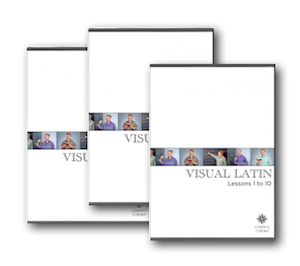
Product Review of "Visual Latin"
I'll just cut to the chase. I love this product! I have been on the fence for almost two years, deliberating over which Latin program to buy for my sons. I'm glad I waited, because Visual Latin came along this year for me to review for The Old Schoolhouse Magazine. As a mom, I have always wanted my children to learn Latin for many reasons. One, it makes learning other languages exponentially easier. Two, knowing Latin can help decipher unknown words on SATs--much of the English language is derived from this ancient Roman language. And three, (I'll just come out and say it), reporting to your in-laws that your children are studying their Latin verbs just sounds like you are doing a bang-up job at homeschooling.
But, if you are looking for a stuffy old Latin program with lots of conjugation drills and pious sounding narrators on tape, find something else. Because with Visual Latin, you get quite the opposite. Dwane Thomas is your child's personal Latin tutor. He introduces the first four lessons, explaining why you should learn Latin and how to really go about learning a foreign language. Do not skip these intro lessons. They will help develop your child's friendship with their Latin teacher. Dwane is like an "Everyman" character. He talks to students in a casual, conversational style and never once acts as if he's reading cue-cards. He'll even flub here and there and just say, "Wait, scratch that, guys. I messed up." As a homeschool mom, who has "messed up" numerous times while teaching a lesson, I appreciate this. It makes me look normal. LOL.
From the first lesson, your child will learn that exact pronunciation is not the key here. It's understanding. Understanding enough to READ Latin. There are several types of pronunciation and the truth is, as Dwane will tell you, the Romans didn't leave us any audio-recordings (ha ha). So, as long as you can learn the language well enough to read it, that's the goal. Lesson One introduces the verb "to be" and the student will complete the lesson knowing how to use the verb as well as many vocabulary words. I like how each time a new vocabulary word is introduced, Dwane shares information such as "silva means forest...it's where we get the word Pennsylvania". My kids like trivia like that.
One of the mottos of Visual Latin is that "it is better to make kids laugh than make them yawn". This is a huge selling point here. With humor as a key ingredient in the instruction, you never want to fast forward or skip any parts of the instruction. A curriculum in no good if your child is staring at the wall while the lesson plays on the computer. If it never catches their attention, it will never be absorbed into their little brains. And Dwane's offbeat sense of humor is goofy enough to keep them paying attention (no offense Dwane, we totally get you).
After each segment of a lesson plays, the words will come on the screen. "Now complete worksheet 2B" (or whatever lesson corresponds to what they just learned). The entire program is very straight-forward and easy to use. With each lesson, there is a A, B and C segment. "A" is Grammar, "B" is Sentences and "C" is Reading and Translation. In the video portion and the written portion, Dwane adds a little more challenge, but still goes at a pace that a beginner can follow. It really does incorporate seeing, listening, saying and writing. Wonderful for all learning types.
You can buy Latin I (Lessons 1-30) on DVD for $80.00 here. You can also purchase the downloads in segments of 10 lessons for $30 each. These can be used on your computer or any portable device such as an iPod. Pretty cool. You can download the first 4 lessons for free on the website as well. I really recommend viewing these free lessons and seeing for yourself how fun Latin can be with Visual Latin!
**Disclaimer: I was provided a copy of the first 10 lessons from Visual Latin in exchange for my honest review, which I have provided here. Please also check out the opinions of some of my Homeschool Crew-mates here.
Sunday, October 9, 2011
And Just To Make You Feel Better About Your Day.....
When you are a Polish Crested chicken, you can't see diddly-squat because of your "hair feathers"--on a good day. But THIS is what happens when it has been raining in Florida for 2 days straight and you just can't stand it in the henhouse any longer. It's the price to pay for being beautiful and fancy.
So, if you're having a rough day, thank the Lord above that you are not my girl, Pierogi. I'm hoping her bonnet fluffs up by tomorrow.
Friday, October 7, 2011
TOS Product Review: Scruble Cube!
Give me a word game, and you have given me the world. I carry crossword puzzles in my purse at all times. My mom and sister and I go on roadtrips with our collector's edition of Scrabble. So when I was given the chance to review Scruble Cube, I knew we were a match made in heaven.
Scruble Cube has been described by many as Rubik's Cube and Scrabble rolled into one twisting-turning game of letter mania. Each 4x4 side has letters with point values. The object is to make a word by lining up letters and recording your points. You get even more points if you tag a 2, 3 or 4x letter score OR a 2 or 3x word score to the beginning or end of your word. Then the play passes to the next player and they try to do the same.
The unique element about Scruble Cube is that your word can start on one side of the cube and "spill over" or "stretch" to another side. Your words have no boundaries and no limits to length! Wild cards are also spread throughout the cube and can be used as any letter. The game gets interesting if you can manage to attach your new word, crossword-puzzle style, to your opponent's previous word. Guess what? You get points for both! Be warned: I know some people who really get cut-throat about their word games.
Scruble Cube comes with a score pad, instructions, and a 1.5 minute sand timer. The edgy packaging has the Scruble Cube suspended in mid-air in the box--very appealing to receive as a gift. You'll want to take a minute in the beginning to get a feel for the way the rows and colums twist around. If you are a "word puzzle" geek, you'll have an advantage over your friends, as 3 letter words come in handy, as do words with obscure letters like "X". You may want to keep a pocket dictionary in your Scruble Cube box in case your opponents challenge your creations.
The award-winning Scruble Cube sells for $24.95 here , a fair price and the going rate for most games today. You have the option of purchasing inexpensive replacement labels in case your game gets a lot of love over the years. And I predict it will!
See what the folks at The Old Schoolhouse Magazine Homeschool Crew had to say about Scruble Cube here
Happy twisting, Word Nerds!
*Disclaimer: I was provided with a free product in exchange for an honest review, which I have provided here.
The Power of The Pudewa
I'm still scratching my head. I have one child that is sort of the model student. Likes to please, picks up concepts pretty easily and so forth. But the other child who has horrendous handwriting, who doesn't like writing, whose spelling is atrocious, looks like this after a writing workshop with Andrew Pudewa:
We had a rare opportunity to attend an Advanced Student Writing Intensive seminar. The theme was "Writing Stories". For two and a half hours (that flew by), approximately 40 kids sat mesmerized by jokes, antectdotes and amazing instruction by Mr. Pudewa. And for the last 24 hours, they have been producing interesting stories on their own, double-spaced, just like Andrew likes it. Every room in the house is riddled with short stories like "The Girl and the Monster", "The Banana People", and "The Almost-True Tale of Robert the Bruce".
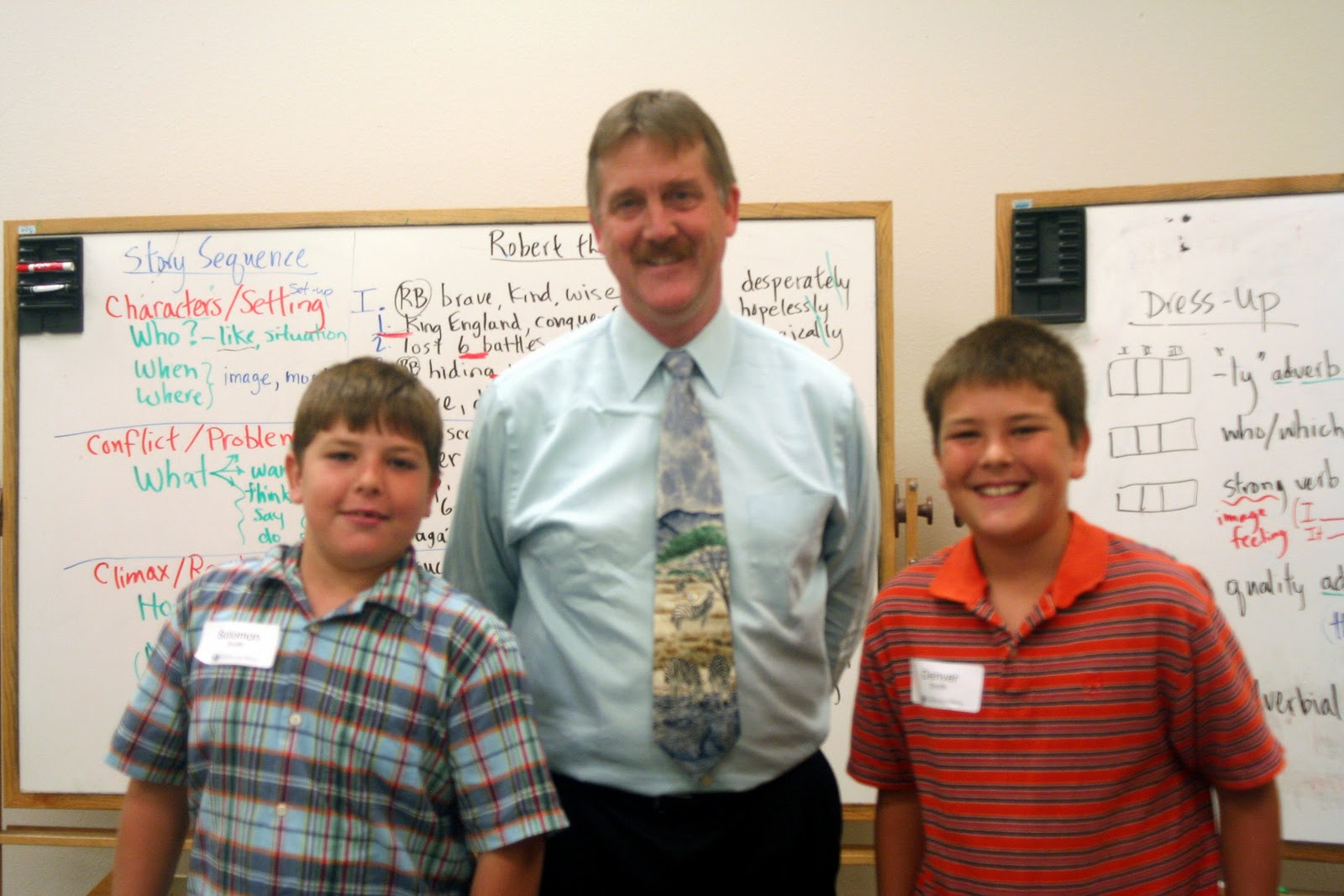
I call it the Power of The Pudewa. Sure, IEW (The Institute for Excellence in Writing) has a pretty amazing product. The techniques they employ for teaching sound technical writing skills are phenomenal. But Andrew Pudewa is The Face of IEW and it is greatly due to him that my son Denver has embraced writing.
Mr. Pudewa understands boys and how boys learn. In fact, he has a lecture called "Teaching Boys and Other Children Who Would Rather Make Forts All Day", which you can download here. He understands what my husband and I have known from the get-go. Boys are not wired to sit still all day. Boys are not wired to work in workbooks, color quietly or write long stories about unicorns and sandcastles. Boys are wild creatures. They crave action, adventure and yes, a little violence. Okay a lot of violence. If the story has flesh scattering and blood flowing, the book will be consumed with happiness by a boy.
So, the first thing that Mr. Pudewa and IEW tell students that puts reluctant writers at ease is this: "Don't worry that you don't know what to write about. I'm going to tell you exactly what to write about. And then I'm going to give you a checklist that will tell you exactly when you're done." Because that's what alot of kids want to know. "When am I "done"?"
Using a variety of source texts, such as paragraphs about jellyfish, inventions, and other high-interest non-fiction subjects, as well as fables and fairy tales, children learn how to outline the paragraph using keywords (no more than 3 per sentence). Then they are able to re-tell the information in speech format, then write about it, dressing it up with colorful adjectives, strong verbs, -ly words and clauses. The result is an original piece of work and a grammar lesson all in one!
I don't claim to be an expert on IEW yet. I've watched the teacher DVDs for Teaching Structure and Style. I am learning this with my kids. I own, but haven't used, several of the products available for the middle/high school students. I'm looking forward to employing this method for the duration of their homeschooling years. I am confident this will give them an edge in college when it comes to annotating, employing the Socratic method, and communicating affectively with any audience. Hand-written essays are still required for many scholarships. A cover letter is still important in the marketplace. The written word is here to stay! And I don't think there is a better program out there for teaching students how to do it well.
![]() |
| Solomon, IEW's Andrew Pudewa, and Denver |
Warning: The fun level of these workshops is intense. It will take alot out of you and leave you looking like this:
Thursday, September 29, 2011
Turtle Dissection!
If you are easily grossed out by upclose photos of reptile entrails, go to the next post. If you have kids that are enthralled by biology and the inner workings of God's amazing creatures, or if you have some future doctors in your house, you may want to check out our experience with a turtle dissection this week!
We ordered three different specimens from Home Science Tools to get us through the first semester of our school year: some clams, some starfish, and one turtle to share. I have to give kudos to HST for the quality of their specimens. They are shipped well, sealed with care and are carefully prepared for you. What I mean is this: I searched frantically online for instructions on how to dissect a turtle. I could have ordered their guide at the same time I ordered the little critters, but I thought for sure I'd be able to find some simple instructions for free on the internet. There is actually very little out there on the web. There is this website that is quite good with full-color photographs of the process, but nothing that actually says, "Cut here, now remove this." I started to panic when I saw some comments like, "you'll need a good saw to remove the shell".
Well, I was delighted to open the sealed package and find that 1.) it didn't smell weird and 2.) the shell was already seperated on three sides so it was really just attached like a hinge. Almost like opening a book. And finding guts inside.
We were able to locate the pectoral muscles, which needed to be cut away to reveal the organs underneath. We marvelled at how important the pectoral muscles were to allow a turtle to pull its entire body weight around. Then we located the heart, lungs, gall bladder, liver and pancreas. We were able to dissect a shark a few weeks ago, so we compared the size of a shark's huge liver to that of a small turtle.

Poor little guy had us poking around his mouth to see his arrow shaped tongue. Since turtles have no teeth, its pointed "beak" and sharp tongue help it eat. We noticed the nostrils on top of the beak. These help it breathe above the water without sticking its entire head out.
Did you know that a turtle's intestines are around 24 inches long? There was also alot of grass and chewed up vegetation still in his stomach. Again, pretty gross on my end, but fascinating to the boys.
Home Science Tools not only prepares their specimens well, but preserves them so that their blood vessels are visible (something they inject prior to shipping) and their organs retain more of their natural color, rather than being all white and faded from traditional preservation techniques. They are very reasonably priced. Clams are $2.50, Starfish are $2.40 and Turtles are just over $11.00. The package says they can be stored at room temperature indefinately, but should really be used within a year. The only space I had available in the house was on the floor in the shipping box in our classroom. Because they didn't really smell like anything interesting, my two black labs didn't tear into it. And thank the Lord. I would not have wanted to come home to that scene on my floor.
I was also really impressed with the Dissection Tool kit. A scalpel with 3 interchangeable blades (it's easier to just use a new blade for each dissection than to try to clean the old ones. They are very sharp!), surgical scissors, a few prodding tools, T-pins, a medicine dropper, etc., all housed in a tool box. The reusable tray and silicone mat give you something to lay your specimen on without touching the table.
As I mentioned, the scalpel blades are real. They are not toys. My boys are fine with them, even when sharing a specimen and cutting together. They use surgical gloves and take precautions and have gotten hurt much worse jumping out of trees. However, if you have kids that tend to flail around and forget that they're holding a razor blade--just be careful!
We are studying Marine Biology right now, so that's why we chose these specimens. We'll soon be sailing into Human Anatomy, which the kids can't wait for because this means EYES and BRAINS! Woo-hoo!
We ordered three different specimens from Home Science Tools to get us through the first semester of our school year: some clams, some starfish, and one turtle to share. I have to give kudos to HST for the quality of their specimens. They are shipped well, sealed with care and are carefully prepared for you. What I mean is this: I searched frantically online for instructions on how to dissect a turtle. I could have ordered their guide at the same time I ordered the little critters, but I thought for sure I'd be able to find some simple instructions for free on the internet. There is actually very little out there on the web. There is this website that is quite good with full-color photographs of the process, but nothing that actually says, "Cut here, now remove this." I started to panic when I saw some comments like, "you'll need a good saw to remove the shell".
Well, I was delighted to open the sealed package and find that 1.) it didn't smell weird and 2.) the shell was already seperated on three sides so it was really just attached like a hinge. Almost like opening a book. And finding guts inside.
We were able to locate the pectoral muscles, which needed to be cut away to reveal the organs underneath. We marvelled at how important the pectoral muscles were to allow a turtle to pull its entire body weight around. Then we located the heart, lungs, gall bladder, liver and pancreas. We were able to dissect a shark a few weeks ago, so we compared the size of a shark's huge liver to that of a small turtle.
Poor little guy had us poking around his mouth to see his arrow shaped tongue. Since turtles have no teeth, its pointed "beak" and sharp tongue help it eat. We noticed the nostrils on top of the beak. These help it breathe above the water without sticking its entire head out.
Did you know that a turtle's intestines are around 24 inches long? There was also alot of grass and chewed up vegetation still in his stomach. Again, pretty gross on my end, but fascinating to the boys.
Home Science Tools not only prepares their specimens well, but preserves them so that their blood vessels are visible (something they inject prior to shipping) and their organs retain more of their natural color, rather than being all white and faded from traditional preservation techniques. They are very reasonably priced. Clams are $2.50, Starfish are $2.40 and Turtles are just over $11.00. The package says they can be stored at room temperature indefinately, but should really be used within a year. The only space I had available in the house was on the floor in the shipping box in our classroom. Because they didn't really smell like anything interesting, my two black labs didn't tear into it. And thank the Lord. I would not have wanted to come home to that scene on my floor.
I was also really impressed with the Dissection Tool kit. A scalpel with 3 interchangeable blades (it's easier to just use a new blade for each dissection than to try to clean the old ones. They are very sharp!), surgical scissors, a few prodding tools, T-pins, a medicine dropper, etc., all housed in a tool box. The reusable tray and silicone mat give you something to lay your specimen on without touching the table.
As I mentioned, the scalpel blades are real. They are not toys. My boys are fine with them, even when sharing a specimen and cutting together. They use surgical gloves and take precautions and have gotten hurt much worse jumping out of trees. However, if you have kids that tend to flail around and forget that they're holding a razor blade--just be careful!
We are studying Marine Biology right now, so that's why we chose these specimens. We'll soon be sailing into Human Anatomy, which the kids can't wait for because this means EYES and BRAINS! Woo-hoo!
Friday, September 23, 2011
TOS Product Review: Games for Competitors—Tri-Cross
It's been a long time since I was so impressed with the quality of a board game. With today's mass-reproduced versions of classics that come in a flimsy box and sell for $4.99, it was refreshing to see something different come our way. Tri-Cross is a clever hybrid of checkers and chess, a strategy game using numbered tiles. There is also a Tri-Cross tile. Each tile has its own set of “rules” (similar to chess). You will quickly learn that a 5 can jump a 4, 3, 2, and 1 and a Tri-Cross tile can only jump a 6. It only takes a few rounds of play, and you'll memorize which pieces can perform what moves pretty quickly. The game board is small. You can't hide from your enemies for long, which keeps you on your toes and keeps you thinking ahead to what your opponent is about to do to sabotage you!
The most astounding part of this game, to us, was the quality of the product. Even my children noticed that these were well-produced pieces. The tiles remind me of my grandmother's old Bakelite tile bracelets from the 1960's. They are very durable and smooth. The board was even thicker than most boards. The pieces are housed in a velvet, draw-string bag.
We also got a chance to review the Eco-Friendly travel version of this game. The board is made from organic cotton, which is folded up and kept in a drawstring organic cotton bag with the same quality pieces. It's nice to see companies like Games For Competitors putting forth an effort to be more environmentally aware.
The first few times we played, the game was over quickly, because one of us (that would be me) wasn't paying attention to all the rules. My 9 year old smoked me. Then, we got a little more competitive and the game went on a little longer. Some games out there can last forever. It's nice when you've got some spaghetti boiling and your kid asks you to play a game. This is the first one I would grab. It's quality time playing a quality game and you aren't going to be cycling around the board 50 times and counting money while the dinner burns!
The only issue that came up for us while playing is that if you aren't paying attention and get your Tri-Cross tile AND your 6 tile taken by your opponent early on in the game, you have very little chance of redeeming yourself. Since the only way to win is to keep a piece in the center Tri-Cross square for 4 turns, or to take all of your opponent's pieces, you need to keep your high value tiles and your Tri-Cross tile unharmed. It's kind of like keeping your Queen in chess. You need her abilities to help you win in the end.
Tri-Cross comes with rules for 2 players and rules for 3 and 4 players. When 2 are playing, only red and black are used. There is also a variation in which the values of the tiles are not revealed until a challenge is presented between two opposing tiles. This makes for an entirely new kind of game, which my children and I both enjoyed!
You may purchase Tri-Cross here and also see tutorials on how to play. The company sells three variations of their game. The eco-friendly travel set sells for $19.95, the standards set sells for $24.95 and the wooden set sells for $35.95. I think these prices are very fair in the current board game market. This is truly a game that can be passed down to the next generation and is worth doing so.
**Disclaimer: Games for Competitors provided my family with the standard game and the travel game in exchange for an honest review, which I have provided here.
Saturday, September 17, 2011
TOS Product Review: AIMS Education Foundation
For the past month or so, we have been using Electrical Connections, an activity guide by AIMS Education Foundation. AIMS stands for "Activities Integrating Math and Science", and in my opinion they have accomplished that task nicely with this book. As excited as my two sons were to rip open the Fed Ex box and see what sort of things they were going to be able to charge, light up or (if they had it their way) explode, I for one, was a little hesitant in my ability to guide them through the activities. I am a literature nerd, an artsy type, a sit under the tree and read Shakespeare kinda girl. I spent most of my middle school science class dreaming about Kirk Cameron (LOL), and what I know today is only from watching alot of Jeopardy.

However, these lessons aren't written for those who are already mad scientists. They are written for grades 4-6. They make it easy for you to prepare and execute some pretty neat experiments with your students. The book is divided into a few sections: Static Electricity, Circuits, Electromagnetism, and the History of Electricity, which includes some biographies and time lines. Most sections have between 6 and 10 activities to perform. But before you begin getting out your wires and paper clips, have the student read the short foldable book in the beginning of each section to familiarize themselves with the new topic. The books are printed in quadrants, designed so that you can fold them into booklets. Just attach them at the "spine" with a rubber band and they are ready to read! They are very kid-friendly with cartoons that illustrate the point but don't seem too babyish. The teacher section is well laid out, explaining the objectives, background information, listing the materials needed, step-by-step instructions and thought-provoking wrap-up questions that guide the students from beginning to end. As long as you gather the materials in advance, there is not alot of preparation on the part of the teacher.
The first third of the book requires only household items like Saran wrap, paper clips, string, foil, etc. Once you get to the section on circuits, you will have to purchase a few items such as batteries, wires, bulbs and alligator clips. These are all available through the AIMS website. However, I just took my book to the local hardware store and they were able to help me out. Stores like Home Depot or Lowe's would also have most of these items, but I found that Ace Hardward sells alot of the wires I needed by the foot, so I only paid for what I needed.
| Experimenting with salt and static electricity. This was very cool. |
| Every activity has a record sheet prepared for your student to keep track of their outcomes. |
The other experiment that we've done so far is "Conductor or Insulator?" This was another big hit, discovering which items conduct electricity. They got to graduate from household items, to bulbs, D-cell batteries and wires for this one! Again, another simple scientific concept broken into manageable bits of information and hands-on experiences for children. Some other opportunities for exploration are: Fiddling with Filaments, Making a Dimmer Switch, The Click Heard Around the World (Samuel Morse), Make a Galvanometer, How to Make an Electric Motor and many, many more!
I really appreciated the CD in the pocket at the back of the book. The CD contains all the book's pages for easy printing, so you don't have to stand at the copier and print them one at a time. I also liked that the writers suggest substitutes for things you may not have at home, like paper clips instead of alligator clips, or modeling clay to hold something in place. Frugal moms like it when we can "make do" with things we already own.
This title sells for $24.95 through the AIMS website here. In the past, I have paid more money for products with much less "meat" than Electrical Connections. I think it is definately a fair value and has enough projects to keep the average homeschooling family busy for at least half of the school year. If you take the suggestions of the guide and incorporate more in-depth reading about Ben Franklin, Thomas Edison, and Nikola Tesla, you could expand upon this topic to your heart's content.
I would definately purchase other titles from AIMS to help bring Math and Science alive in our homeschool. We were extremely happy with this product.
**Disclaimer: I was provided with a copy of Electrical Connections in exchange for an honest review, which I have provided here.
Subscribe to:
Posts (Atom)